
About Hefestos

About Hefestos

The HEFESTOS Hub is a European Commission–funded initiative designed to support Europe’s transition away from Brominated Flame Retardants (BFRs) towards safer and more sustainable alternatives. The initiative is coordinated by AIMPLAS as an independent technical secretariat.

BFRs have long been used to meet fire-safety requirements in construction, automotive, cables and other polymer-intensive sectors. However, mounting evidence of environmental persistence and harmful health effects has increased the urgency to replace them.

Substitution efforts remain slow and fragmented due to inconsistent methodologies, limited data and insufficient cross-sector coordination. HEFESTOS addresses these barriers by testing a harmonised analytical framework within a trusted, non-competitive and legally compliant cooperation environment that strengthens public–private dialogue and improves the quality of technical assessments.

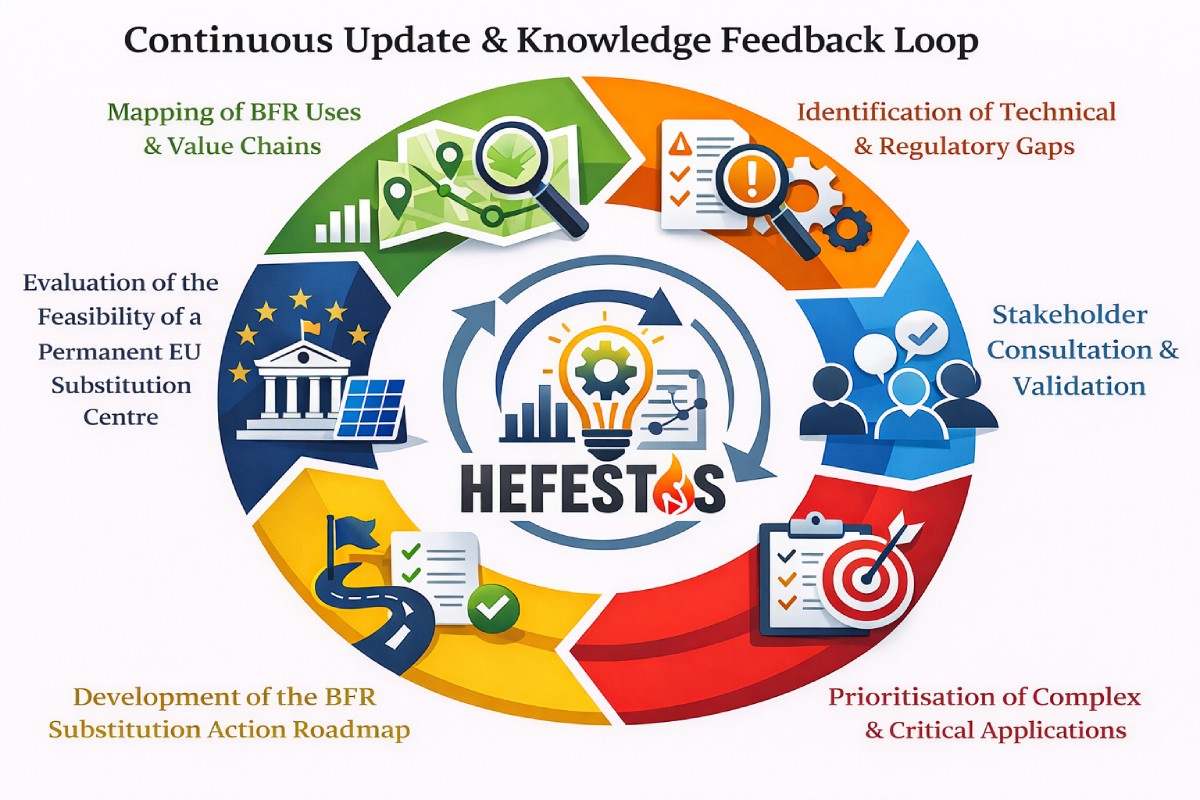
HEFESTOS is not a regulatory body and does not impose obligations. It operates as a structured pilot initiative to assess the feasibility of a future EU-level Substitution Centre.
Background


Modern industries, from construction and automotive to electronics and textiles, rely extensively on synthetic polymers. While these materials offer lightness, versatility and cost‑efficiency, they also present a major drawback: high flammability. Many commonly used plastics ignite easily, release intense heat and toxic fumes, and can accelerate the spread of fire, especially in enclosed or densely populated environments.

To address these safety concerns, flame retardants (FRs) are added to materials during manufacturing to slow ignition and reduce fire propagation. Their use has expanded rapidly over the past decades, driven by stricter fire‑safety standards and the increasing presence of flammable polymers in modern products and infrastructure.

Among the different types of flame retardants, brominated flame retardants (BFRs) have been widely used due to their effectiveness. They are found in insulation materials, cables, automotive components, electronic housings, textiles and many other applications. However, growing scientific evidence has revealed that several BFRs pose significant risks to human health and the environment. These substances can release toxic by‑products during combustion, persist in ecosystems, and bioaccumulate in living organisms.

As a result, regulatory pressure has increased globally. In Europe, tools such as REACH and the Stockholm Convention on Persistent Organic Pollutants have led to the identification, restriction and in some cases global elimination of certain BFRs. This regulatory momentum is pushing industries towards the development and adoption of safer, more sustainable alternatives.

In this context, supporting coherent and transparent chemical substitution processes is essential. Industries need clear methodologies, comparable assessments and stronger collaboration mechanisms to transition away from hazardous flame retardants without compromising fire safety or performance.

Join Hefestos HUB

Become part of a trusted EU level cooperation platform advancing the substitution of hazardous flame retardants.
Share your expertise, access structured knowledge and contribute to a coordinated European approach to BFR substitution.
Join the Hub

Benefits of joining


Organisations participating in HEFESTOS gain access to unique strategic and technical advantages, including:

Access to the most up to date technical and regulatory knowledge on BFR uses and alternatives across key sectors.
The opportunity to help shape the EU’s future approach to hazardous chemicals substitution and contribute directly to a coordinated transition strategy.
Participation in a trusted, competition-compliant cooperation space that enables open technical dialogue while protecting sensitive information through NDAs and clear governance rules.
Involvement in pilot actions and voluntary pledges that demonstrate practical pathways for substituting BFRs in real industrial settings.
Connection with key actors across the entire BFR value chain and the opportunity to build collaborations that would otherwise be difficult to stablish.
Contribution to the official EU BFR Substitution Action Roadmap, ensuring that sector-specific priorities and needs are adequately represented.
Gain visibility as a forward looking organisation committed to sustainability and safer chemicals, including the option to feature your logo and initiatives on the HEFESTOS website.
Access to expert guidance from leading EU and U.S. specialists in flame retardants, fire safety and substitution strategies.
Alignment with broader EU initiatives on chemicals, circularity and Safe-and-Sustainable-by-Design, and identification of synergies with ongoing or planned projects.

How Participation Works

If your organisation is considering joining the HEFESTOS Hub, participation follows a structured and transparent process designed to ensure balanced representation across the value chain and meaningful engagement by all actors.

HEFESTOS is conceived as an open and progressive cooperation space that grows as new organisations join.

Participation process:
  1. Send your Expression of Interest
    Use the website contact form to inform the HEFESTOS team of your interest in joining the Hub. No sensitive or company‑specific data are required at this stage.
  2. Sign the NDA & MoU (Onboarding)
    Organisations will receive a standard onboarding package consisting of:
    • Non‑Disclosure Agreement (NDA): All participants sign a Non-Disclosure Agreement that governs access, use, protection and reporting of confidential information, under clearly defined conditions for information sharing during meetings, interviews or questionnaires.
    • Memorandum of Understanding (MoU): The Memorandum of Understanding clarifies roles, responsibilities and engagement principles, and defines participation rules, the scope of engagement, and how information may be used in aggregated or anonymised form in public outputs, including its potential contribution to future voluntary pledges or pilot actions.
    This framework guarantees strict compliance with EU competition law and creates a predictable and trusted environment for technical collaboration.
  3. Join the HEFESTOS Coordination Group
    Once onboarded, organisations become part of the Coordination Group, the central forum of the Hub. Members may review structured evidence on BFR uses, alternatives and value chains, discuss complex applications and substitution barriers, and contribute inputs to the BFR Substitution Action Roadmap that will inform EU‑level actions.
  4. Take part in consultations and technical activities
    Members choose how and when to engage, depending on relevance and availability. Typical activities include:
    • Questionnaires capturing comparable, cross‑sector input (especially helpful for SMEs),
    • one‑to‑one interviews on specific applications or barriers,
    • technical and sector meetings to validate findings and prioritise use cases,
    • feedback on analytical drafts (applications map, alternatives landscape, gap analysis),
    • participation in pilot actions and potential voluntary pledges (actor‑specific commitments) that demonstrate practical substitution pathways.
    All tools are designed to avoid any exchange of commercially sensitive information and are moderated by an independent technical secretariat to keep discussions within a safe scope.
  5. Benefit from continuous visibility
    Participating organisations may:
    • display their logo on the HEFESTOS website to signal commitment to safer chemicals,
    • share links to relevant projects or initiatives (e.g., EU‑funded or national),
    • help surface emerging solutions and knowledge that feed into the collective evidence base.
  6. Strict compliance with EU competition law
    The cooperation framework includes safeguards to prevent any exchange of commercially sensitive information. Discussions are moderated by AIMPLAS as a neutral technical facilitator.
  7. Anonymised and aggregated outputs
    Any information contributed by organisations is compiled in aggregated or non‑attributable format. No company‑specific data are made public or shared without explicit consent.
  8. Secure data handling and protection
    All data are stored on secure servers following the Data Management Plan and EU GDPR requirements. Access is restricted to authorised project staff.

Stakeholders

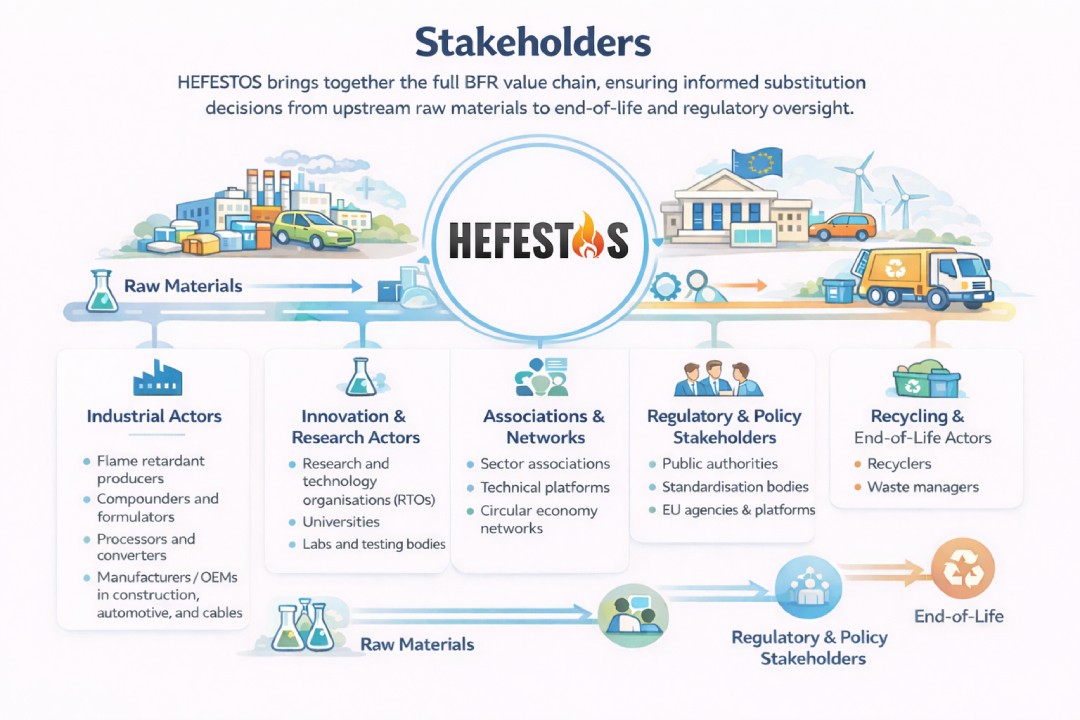
HEFESTOS brings together the full BFR value chain, ensuring that substitution decisions are informed by perspectives ranging from upstream raw materials to end-of-life and regulatory oversight. The initiative welcomes:

  • Industrial actors
    • flame retardant producers
    • compounders and formulators
    • processors and converters
    • manufacturers / OEMs in construction, automotive and cables
  • Innovation and research actors
    • research and technology organisations (RTOs)
    • universities
    • labs and testing bodies
  • Regulatory and policy stakeholders
    • public authorities
    • standardisation bodies
    • EU agencies and platforms
  • Associations and networks
    • sector associations
    • technical platforms
    • circular economy networks
  • Recycling and end-of-life actors
    • recyclers
    • waste managers

The Hub is open to any organisation willing to contribute expertise and participate in the coordinated transition towards safer flame-retardant strategies.

Whether upstream or downstream, a technology provider or a public authority, each perspective is essential to building a realistic and coordinated European transition towards safer flame retardant solutions.

Stakeholders

Hefestos Hub at media

  • Nuevas tecnologías impulsan innovadoras prestaciones de los acabados superficiales

    06/03/2024
  • MEJORA DEL COMPORTAMIENTO FRENTE AL FUEGO DE DIFERENTES MATRICES POLIMÉRICAS CON ADITIVOS IGNÍFUGOS INNOVADORES PROVENIENTES DE RECURSOS RENOVABLES

    15/11/2023
    Tecnología y Equipamiento para la industria Química
  • MEJORA DEL COMPORTAMIENTO FRENTE AL FUEGO DE DIFERENTES MATRICES POLIMÉRICAS CON ADITIVOS IGNÍFUGOS INNOVADORES PROVENIENTES DE RECURSOS RENOVABLES

    01/08/2023
    Plásticos Universales
  • Mejora del comportamiento frente al fuego de diferentes matrices poliméricas con aditivos ignífugos innovadores provenientes de recursos renovables

    27/06/2023
  • Aimplas desarrolla nuevos recubrimientos y aditivos ignífugos, antihielo, aislantes térmicos e hidrofóbicos más sostenibles y eficientes

    03/03/2023
  • Recubrimientos y aditivos ignífugos, antihielo, aislantestérmicos e hidrofóbicos sostenibles y eficientes

    03/03/2023
  • Aimplas desarrolla nuevos recubrimientos y aditivos ignífugos más sostenibles y eficientes

    28/02/2023
  • AIMPLAS desarrolla nuevos recubrimientos y aditivos ignífugos, antihielo, aislantes térmicos e hidrofóbicos más sostenibles y eficientes

    27/02/2023
  • Aimplas desarrolla nuevos recubrimientos y aditivos ignífugos, antihielo, aislantes térmicos e hidrofóbicos más sostenibles y eficientes

    24/02/2023
  • AIMPLAS desarrolla nuevos recubrimientos y aditivos ignífugos, antihielo, aislantes térmicos e hidrofóbicos más sostenibles y eficientes

    23/02/2023
    IDE
  • AIMPLAS desarrolla nuevos recubrimientos y aditivos más sostenibles y eficientes

    22/02/2023
  • Aimplas desarrolla nuevos recubrimientos y aditivos ignífugos, antihielo, aislantes térmicos e hidrofóbicos

    22/02/2023
  • AIMPLAS desarrolla nuevos recubrimientos y aditivos ignífugos, antihielo, aislantes térmicos e hidrofóbicos más sostenibles y eficientes

    22/02/2023
  • Aimplas desarrolla nuevos recubrimientos y aditivos ignífugos, antihielo, aislantes térmicos e hidrofóbicos más sostenibles y eficientes

    21/02/2023
  • Aimplas desarrolla nuevos recubrimientos y aditivos ignífugos, antihielo, aislantes térmicos e hidrofóbicos más sostenibles y eficientes

    21/02/2023
  • AIMPLAS trabaja en nuevos recubrimientos funcionales

    21/02/2023
  • Nuevos recubrimientos y aditivos de AIMPLAS

    21/02/2023
  • AIMPLAS desarrolla nuevos recubrimientos y aditivos ignífugos, antihielo, aislantes térmicos e hidrófobos más sostenibles y eficientes

    15/02/2023
    Revista Plásticos Modernos papel